Free Investment Education
Learn to Invest on the
Nairobi Securities Exchange
From your first share to building a full portfolio. Clear, simple lessons for every Kenyan.
Start Learning ↓
From your first share to building a full portfolio. Clear, simple lessons for every Kenyan.
Start Learning ↓
OUR MISSION
NARA exists to make investing accessible to every Kenyan. We believe clear, honest education is the first step to building wealth. No jargon, no gatekeeping — just practical knowledge you can act on today.
What is investing, how the NSE works, buying your first share, and understanding dividends.
Financial statements, key ratios, market sectors, and building your investment strategy.
Full company analysis walkthrough, valuation methods, and portfolio construction.

Investing means putting your money into something that can grow in value over time. Think of it like planting a mango tree. You spend a little money on the seedling today, you water it, and years later it gives you mangoes you can eat or sell. That tree keeps giving you mangoes year after year without you having to buy a new one.
When you invest in the stock market, you are buying a small piece of a real company. If that company does well and makes more money, your piece becomes more valuable. Some companies even share their profits with you directly, just like that mango tree sharing its fruit.
A savings account in Kenya might give you 3-7% interest per year. But inflation (the rising cost of things like food, rent, and transport) is often 5-8% per year. This means your money in the bank is actually losing buying power over time. A loaf of bread that costs KES 55 today might cost KES 70 in a few years.
The stock market has historically given higher returns than savings accounts, though it comes with more risk. The key is learning how to manage that risk, which is exactly what this course teaches you.
Investing is not gambling. When you buy shares, you are buying ownership of a real business that employs people, sells products, and earns profits. Your job as an investor is to pick good businesses.
The Nairobi Securities Exchange (NSE) is like a big market, similar to Gikomba or Marikiti, but instead of clothes or vegetables, people buy and sell pieces of companies. It has been operating since 1954 and is one of the largest stock exchanges in Africa.
Over 60 companies are listed on the NSE. These are some of the biggest companies in Kenya: Safaricom, Equity Bank, KCB, East African Breweries, BAT Kenya, and many more. When you buy shares on the NSE, you become a part-owner of these companies.
The NSE 20 Share Index tracks the 20 most actively traded companies. The NASI (NSE All Share Index) tracks all listed companies. When people say "the market went up," they usually mean these indices increased.
You can check live NSE prices for free on the NSE website (nse.co.ke), through Ziidi Trader on M-PESA, or through your stockbroker's online platform.
Imagine a whole chapati represents a company. Now cut that chapati into thousands or even billions of tiny pieces. Each tiny piece is a share. When you buy one piece, you own a tiny part of the whole chapati (the company).
For example, Safaricom has about 40 billion shares. If you buy 1,000 shares at KES 28 each, you spend KES 28,000 and now own a tiny fraction of Safaricom. You are now a shareholder: a real part-owner of the biggest company in East Africa.
There are two ways to buy shares on the NSE. The easiest is through Ziidi Trader, Safaricom's M-PESA stock trading platform. If you have M-PESA, you can buy your first share in minutes.
Launched in February 2026, Ziidi Trader lets you buy and sell NSE shares directly from the M-PESA app. No paperwork, no CDS account application, no broker account needed. It is operated in partnership with the NSE and Kestrel Capital (a CMA-licensed broker), so your trades are fully regulated and your shares are legally yours.
Ziidi Trader orders are "Good Till Day" — if your order is not matched by market close (3:00 PM), it expires and your money is returned. Trading hours are Monday to Friday, 9:30 AM to 3:00 PM. Ziidi Trader has already captured about 40% of all trades on the NSE.
You can also buy shares the traditional way through a licensed stockbroker. This gives you a personal CDS account in your own name and access to more detailed research platforms.
When a company makes a profit, the board of directors can decide to share some of that profit with shareholders. This payment is called a dividend. Think of it like owning a rental apartment: even if you do not sell the apartment, you receive rent money every month. Dividends are like the "rent" you receive for owning shares.
Not all companies pay dividends. Some companies prefer to keep all their profits and reinvest them to grow the business faster. But many established Kenyan companies pay dividends regularly.

Dividend yield tells you what percentage return you are getting from dividends alone. The formula is simple:
If you take your dividends and use them to buy more shares, those new shares will also earn dividends. Over many years, this "compounding" effect can dramatically grow your wealth. This is one of the most important concepts in investing.

Before you invest in any company, you should look at its financial statements. This is like checking the health of a cow before you buy it. You would not pay good money for a sick cow. Financial statements tell you if a company is "healthy" or "sick."
Every listed company on the NSE is required by law to publish their financial results. You can find them on the company's website or the NSE website. There are three main statements to look at:
This tells you how much money the company earned and how much it spent over a period (usually one year). The key numbers are:
If revenue is growing year after year and net profit is positive and increasing, the company is doing well.
This is a snapshot of what the company owns versus what it owes on a specific date. Think of it as the company's "net worth" statement.
A strong balance sheet has more assets than liabilities and growing equity over time.
A company can show a "profit" on paper but still be running out of actual cash. The cash flow statement shows real money moving in and out. It has three parts:
Go to the company's investor relations page or the NSE website. Listed companies publish half-year and full-year results. Annual reports have the most detail.
Financial ratios help you compare companies and decide if a share is cheap, fairly priced, or expensive. Think of ratios as "scores" that summarize a company's performance in one number.
| Ratio | What It Tells You | Formula |
|---|---|---|
| P/E Ratio | How many years of earnings you are paying for | Share Price ÷ EPS |
| P/B Ratio | Price vs. the company's book value | Share Price ÷ Book Value/Share |
| EPS | Profit earned per share | Net Profit ÷ Total Shares |
| Dividend Yield | Annual dividend return as % | (Dividend ÷ Price) × 100 |
| ROE | How well the company uses shareholders' money | (Net Profit ÷ Equity) × 100 |
| Debt/Equity | How much debt vs. equity | Total Debt ÷ Total Equity |
P/E Ratio: If a share has a P/E of 6, it means you are paying 6 years' worth of earnings. Lower P/E can mean the share is cheap (or has problems). Higher P/E can mean it is expensive (or expected to grow fast). Most NSE bank stocks trade at P/E of 4-8, which is low globally.
P/B Ratio: A P/B below 1.0 means the share trades below the company's book value. Many Kenyan bank stocks trade at P/B of 0.7-1.5, meaning you can buy them for less than or near their net asset value.
ROE: Above 15% is generally very good. Many Kenyan banks have ROE of 18-25%, which is excellent by global standards.
The NSE has companies from different sectors of the economy. Understanding sectors helps you diversify so that if one sector does poorly, others can balance it out.
| Sector | Key Companies | Notes |
|---|---|---|
| Banking | Equity, KCB, Co-op, ABSA, Stanbic, NCBA, StanChart | Largest sector. Banks drive Kenya's economy. |
| Telecom | Safaricom | ~40% of NSE market cap. M-PESA is a global fintech leader. |
| Manufacturing | EABL, BAT Kenya, Bamburi | Consumer goods and industrial production. |
| Insurance | Britam, Jubilee, CIC, Sanlam | Growing as more Kenyans access insurance. |
| Energy | KenGen, Kenya Power, TotalEnergies | Essential services, often government-influenced. |
| Agriculture | Kakuzi, Limuru Tea, Sasini | Tea, coffee, and horticulture exports. |
A good portfolio does not put all money in one sector. Spread across at least 3 different sectors. Banking dominates the NSE (50%+ of market value), so make sure you also hold companies from other sectors.
Buying shares without a strategy is like going to Gikomba without knowing what you need. You will spend money on things you do not need and miss what you actually came for.
1. Dividend Investing — Buy companies that pay regular, high dividends. Your goal is steady income. Best NSE picks: BAT Kenya (8.5% yield), ABSA (8%), Co-op Bank (7%), Stanbic (7%).
2. Growth Investing — Buy companies whose earnings are growing fast. You care more about share price growth than dividends. Best NSE picks: Equity Group, Safaricom.
3. Value Investing — Look for shares trading below their true value (low P/E, low P/B). Buy cheap, wait for the market to recognize the real worth. Best NSE picks: KCB (P/B ~0.9), Co-op Bank (P/B ~0.8), NCBA (P/B ~0.7).
Let us walk through a real company analysis step by step using Safaricom, the largest company on the NSE. Apply this same process to any listed company.
Safaricom provides mobile voice, data, and financial services (M-PESA) to over 40 million subscribers in Kenya. M-PESA processes over KES 35 trillion in transactions annually and is the world's leading mobile money platform.
M-PESA is the growth engine. Voice is shrinking. Watch whether M-PESA growth can offset voice decline.
| Metric | Value | Assessment |
|---|---|---|
| Revenue | ~KES 354B | Growing year-on-year |
| Net Profit | ~KES 76B | Strong profitability |
| Net Margin | ~21% | Very healthy for a telco |
| P/E Ratio | ~14 | Higher than banks (growth premium) |
| Dividend Yield | ~4% | Moderate, consistent payer |
| Debt/Equity | ~0.5 | Manageable debt |
| ROE | ~35% | Exceptional |
A "moat" protects a company from competitors, like a moat around a castle. Safaricom's moat is M-PESA. Over 30 million Kenyans use it daily. Competitors like Airtel Money exist but have not come close. When everyone uses M-PESA to send money, it is almost impossible for people to switch. This is called a "network effect."
High-quality company with a strong moat, solid profitability, and consistent dividends. The higher P/E is justified by its dominant market position and growth potential. A good core holding for any Kenyan portfolio.
Follow these 6 steps for any NSE company: understand the business, check revenue sources, analyze financials, assess competitive position, identify risks, make your verdict.
Valuation means figuring out what a share is actually worth, so you know if the current price is too high, too low, or just right. You would not buy a phone without comparing prices. Same idea with shares.
The simplest method. Compare a company's P/E ratio to similar companies.
If you buy a share for the dividends, estimate its value based on future dividends.
For banks and financial companies, book value is very useful.
Use multiple methods together. If P/E says cheap, P/B says cheap, and dividends are strong, that gives you more confidence. If methods disagree, dig deeper.
Portfolio construction is how you put all your investments together. A good portfolio is like a balanced meal: you need different food groups (sectors), the right portion sizes (allocations), and it should suit your needs (risk tolerance).
Check your portfolio every 6 months. If a position has grown more than 5% above its target allocation, consider selling some to rebalance.
Use the Portfolio Builder below to select NSE companies, set allocations, and see how your portfolio could perform over different time periods.
Select NSE companies, set your investment amount and time horizon, and see projected performance based on historical averages. Equal-weight allocation is used automatically. For educational purposes only.

Select Companies (click to add)
* Projections use historical average returns and assume constant dividend yields. Actual results will vary. Past performance does not guarantee future results.
Kenyans often undervalue their own companies. Here is how NSE companies compare with some of the world's biggest names.

Safaricom is more profitable with higher ROE. M-PESA gives it a unique advantage AT&T does not have.
Equity trades at nearly half JPMorgan's P/E with higher ROE and a much higher dividend yield.
KCB trades below book value with a dividend yield 2.5x higher than Wells Fargo. East Africa's largest bank by assets.
BAT Kenya offers a higher dividend yield than its American counterpart with a similar valuation.
Stanbic trades at half the P/E of US Bancorp with higher ROE and nearly double the dividend yield.
ABSA Kenya offers one of the highest dividend yields on the NSE at 8%, more than double Citigroup's.
Many NSE companies trade at lower valuations with higher dividend yields than American counterparts, while delivering competitive or superior ROE. The Kenyan market offers opportunities that many local investors overlook while chasing foreign stocks.
NARA is building Kenya's first comprehensive investment education platform. Join us in transforming how Kenyans build wealth.
Building Kenya's first AI investment tutor — personalized lessons, real-time Q&A, and smart portfolio guidance powered by artificial intelligence.
NARA personnel in all 47 counties teaching communities how to invest on the NSE. From Mombasa to Turkana, financial literacy for every Kenyan.
Practical finance curriculum in high schools and universities across Kenya. Teaching the next generation to invest, not just save.
Partners, sponsors, educators — let's build this together.
partner@nara.co.keDownload free Excel templates to take control of your finances. Track every shilling, build your net worth, and monitor your NSE portfolio.

Plan your income and expenses month by month. Set spending limits for rent, food, transport, M-PESA, and savings goals.
Download Free ↓Log every transaction, categorize your spending, and see where your money goes. Daily, weekly, and monthly views with automatic totals.
Download Free ↓Track your total wealth — assets like savings, land, stocks, and M-PESA vs liabilities like loans and debts. Watch your net worth grow over time.
Download Free ↓Monitor your NSE shares — track buy price, current value, dividends received, and total returns for every stock you own.
Download Free ↓Understanding the economy helps you make smarter investment decisions. Here are the fundamentals every Kenyan investor should know.
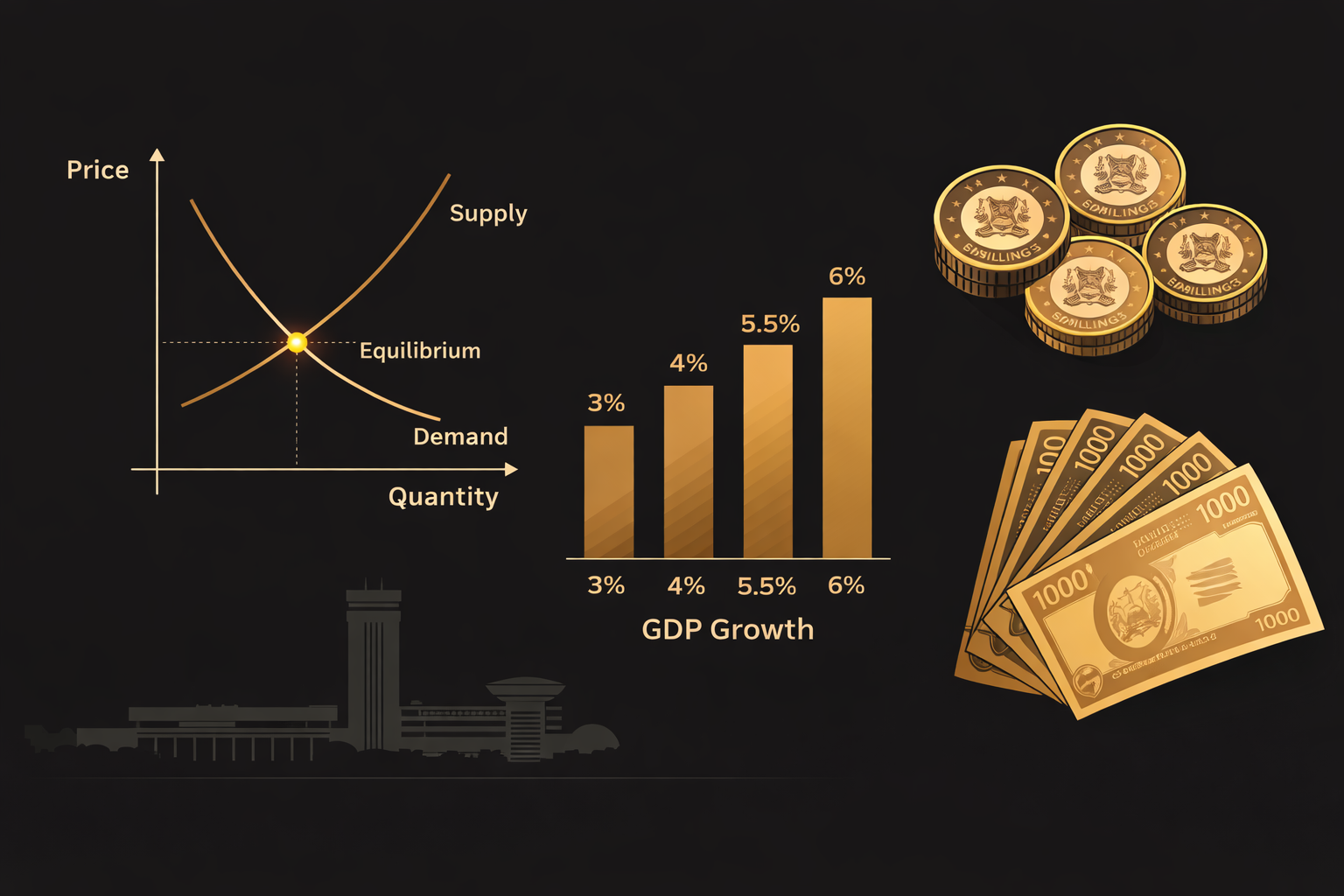
When more people want a product (high demand) but there is less of it (low supply), prices rise. This is why Safaricom shares go up when everyone wants to buy — and why matatu fares increase during rush hour. The NSE itself is a live supply-and-demand marketplace.
Inflation is when prices rise over time, so your KES 1,000 buys less next year than it does today. Kenya has averaged 6-8% annually. If your savings earn less than inflation, you are losing purchasing power. Investing in stocks or bonds can help you beat inflation and grow your wealth.
The Central Bank of Kenya (CBK) sets the base lending rate, which affects everything — loan costs, savings returns, and stock prices. When rates are high, borrowing is expensive and stocks often dip. When rates drop, companies borrow cheaply, grow faster, and stock prices tend to rise.
Gross Domestic Product (GDP) measures Kenya's total economic output. Kenya has grown 4-6% annually in recent years. A growing economy means companies earn more, hire more, and their stock prices reflect that growth. GDP growth is a strong signal for NSE performance.
The Kenyan government borrows money by selling Treasury Bills (short-term, 91-364 days) and Treasury Bonds (long-term, 1-30 years). These are considered very safe investments with returns of 9-16%. They are a good foundation before moving into NSE stocks for higher growth potential.
The KES/USD exchange rate affects companies that import or export goods. When the shilling weakens, imports cost more (hurting companies like Kenya Airways) but exports earn more (helping tea and flower exporters). Understanding this helps you pick the right NSE stocks during currency shifts.
In Kenya, capital gains tax on property is 15%, while NSE share capital gains are currently exempt. Dividends are taxed at 15% withholding tax, deducted automatically. Understanding tax implications helps you keep more of your investment returns and make smarter financial decisions.
Do not put all your eggs in one basket. Spreading your money across stocks, bonds, savings, and real estate reduces risk. If Safaricom dips, your KCB shares or T-Bills might be up. A diversified portfolio protects your wealth and smooths out the ups and downs of the market.